Controllers Built for Everyone: The Quiet Revolution Reshaping Who Belongs in Gaming
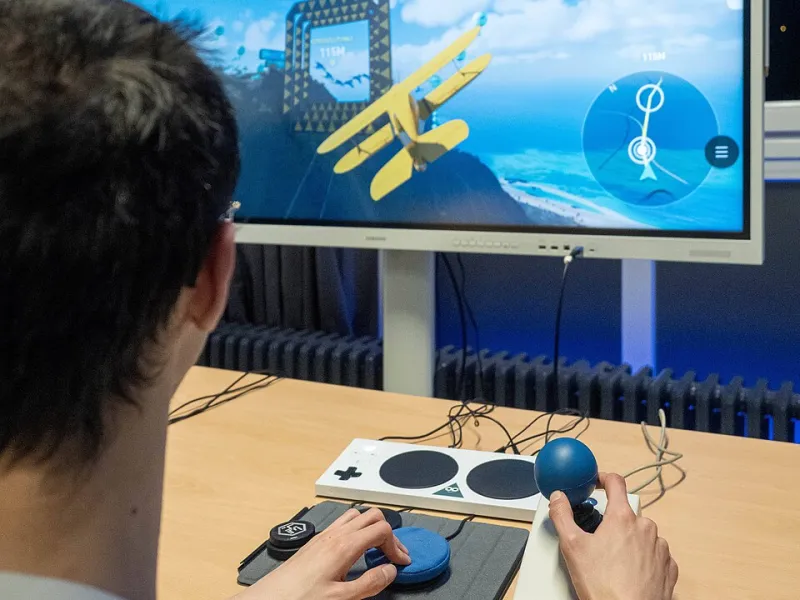
Photo: InclusiveGameLab, CC BY-SA 4.0, via Wikimedia Commons
For most of gaming's history, the assumption baked into every hardware design was simple: two hands, ten fingers, full motor control, standard reaction time. If you didn't fit that mold, the industry more or less shrugged. You either found workarounds on your own or you didn't play. Neither option was acceptable—it just wasn't questioned often enough.
That's changing. Slowly, unevenly, and with plenty of room left to grow, the gaming world is finally building technology that treats accessibility as a feature rather than an afterthought. And the shift is a bigger deal than the mainstream gaming press tends to acknowledge.
The Hardware That Started the Conversation
When Microsoft launched the Xbox Adaptive Controller back in 2018, it wasn't just a product launch—it was a statement. The XAC is a large, flat pad with two programmable buttons and a row of 3.5mm jacks that connect to external switches, joysticks, mounts, and other assistive devices. It's designed to work alongside whatever specialized equipment a player already uses, rather than forcing them to abandon their existing setup.
The price tag—around $100—was steep for what looked like a minimalist slab of plastic. But the design philosophy behind it was genuinely different. Microsoft partnered directly with organizations like AbleGamers, SpecialEffect, and the Cerebral Palsy Foundation during development. These weren't advisory cameos for a press kit. Those organizations shaped the hardware.
Since then, the XAC has become a reference point in accessibility conversations, but it hasn't exactly triggered a flood of competitors. Sony's PlayStation 5 Access Controller, released in late 2023, finally gave PlayStation players a comparable option—five years later. Nintendo, despite its reputation for creative hardware, still doesn't have a dedicated adaptive peripheral. The gap between good intentions and actual products remains wide.
Software Accessibility Is Where the Real Action Is
Hardware is visible and easy to photograph for a press release. But the deeper, more scalable work is happening in software—specifically, in how studios are building accessibility options directly into games.
Naughty Dog's The Last of Us Part II is the most cited example, and for good reason. When it launched in 2020, it shipped with over 60 accessibility features: customizable controls, high-contrast modes, audio cues for players with hearing impairments, text-to-speech for menus, and options to reduce the speed of action sequences. It wasn't a stripped-down accessibility mode tucked behind a warning screen. It was woven into the core experience.
The result was that players who had never been able to finish an action game—or any game—completed it. That's not anecdotal. Organizations that track gaming accessibility, like Can I Play That?, documented responses from players with visual impairments, motor disabilities, and cognitive differences who described TLOU2 as the first game they'd ever seen through to the credits.
More recently, titles like Forza Horizon 5, Celeste, and God of War: Ragnarök have pushed accessibility options further into the mainstream. Celeste in particular is interesting because it's an indie platformer—a genre historically brutal to players with motor challenges—that added an Assist Mode letting players slow the game down, skip levels, or toggle invincibility without judgment. The developers explicitly said the mode wasn't cheating. That framing mattered.
Who's Still Falling Short
For every studio getting it right, there are ten that treat accessibility as a checkbox. Tiny font sizes with no scaling option. Colorblind modes that only cover one type of color vision deficiency. Button remapping buried in menus that aren't screen-reader compatible. Tutorials that rely entirely on visual cues.
The fighting game genre—one of the most competitive and culturally rich corners of gaming—has been particularly slow to adapt. Complex button inputs, tight timing windows, and a competitive culture that sometimes conflates difficulty with legitimacy create a hostile environment for players with motor disabilities. There are community-driven workarounds, like one-button controller mods and macro-friendly arcade sticks, but official support from publishers is rare.
Multiplayer shooters have a similar problem. Aim assist settings exist, but they're almost always tuned for competitive balance rather than genuine accessibility. The line between "help for disabled players" and "unfair advantage" gets drawn in ways that often leave disabled players on the wrong side of it.
The Business Case Nobody Should Need to Make
Here's a number worth sitting with: according to the CDC, roughly 61 million adults in the United States live with some form of disability. The gaming industry likes to talk about expanding its audience, about reaching new demographics, about growth. Accessibility is one of the most direct paths to all three of those goals—and yet it still gets treated like a charity initiative rather than a market opportunity.
AbleGamers, one of the leading nonprofit organizations in this space, has connected thousands of players with adaptive equipment and gaming setups. Their work is necessary precisely because the commercial market hasn't fully stepped up. But the nonprofit model shouldn't be the primary delivery mechanism for basic inclusion.
When accessibility features are built well, they benefit more than disabled players. Subtitle options help players in noisy environments. Reduced motion settings help people with vestibular disorders—and also players who get motion sick. Remappable controls help anyone with an unconventional grip or a broken trigger. Good accessibility design is, in many cases, just good design.
The Standard Is Rising, Whether Studios Like It or Not
The Game Accessibility Guidelines—a collaborative framework developed by a broad coalition of developers, researchers, and accessibility advocates—has been around since 2012. It lays out basic, intermediate, and advanced recommendations for making games more accessible. It's free. It's detailed. And a significant portion of the industry still hasn't read it.
But pressure is building from multiple directions. Players are louder about accessibility on social media than they've ever been. Journalists who cover the space—outlets like Can I Play That? and mainstream sites that have started taking the topic seriously—are holding studios accountable at review time. And there's a growing cohort of developers who came up playing games despite their disabilities and are now building the titles they wish had existed.
The Xbox Game Studios accessibility team has started publishing detailed accessibility reports for their first-party titles before launch. It's a transparency move, but it also sets a benchmark that other studios can be measured against.
What Comes Next
The adaptive controller market is small but growing. Third-party manufacturers are starting to build modular, customizable input devices at lower price points. Eye-tracking technology, once reserved for expensive assistive tech, is beginning to appear in gaming peripherals. Voice control integration is improving. The hardware toolkit is expanding.
More importantly, the conversation is shifting. Accessibility in gaming used to be framed as accommodation—something you did for a niche audience out of obligation. The better framing, the one that's slowly taking hold, is that accessible games are better games. They're more flexible, more thoughtful, and available to more people.
The gaming community has always been bigger than the industry gave it credit for. Adaptive controllers and robust accessibility features aren't creating new gamers—they're finally acknowledging the ones who were already there.