Logged In, Tuned Out: The Hidden Loneliness of Playing Games With Friends
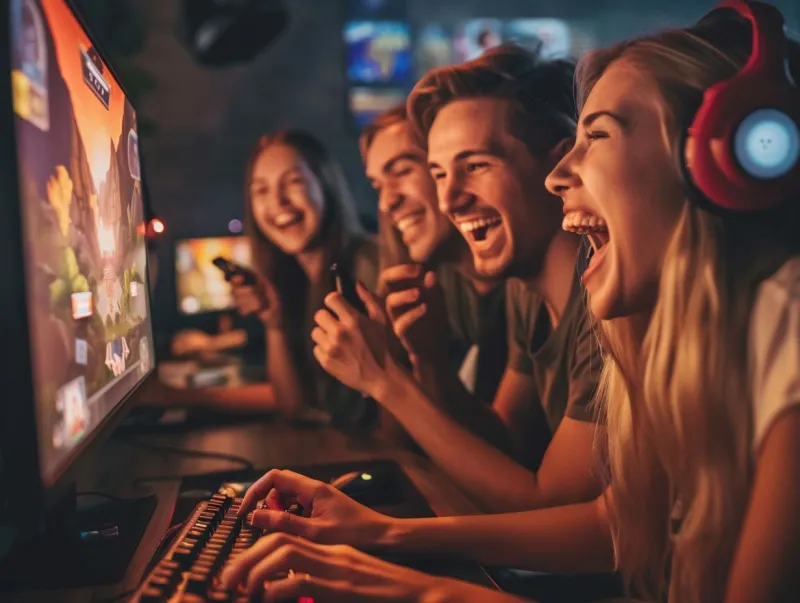
Photo: friends gaming together online feeling isolated at computers, via api.guul.games
Here's a scenario that probably sounds familiar. You've just wrapped up a two-hour session of Destiny 2 with your usual crew. You cleared the activity, hit your milestones, maybe even cracked a few jokes in voice chat. But when you close the app and sit back in your chair, there's this weird hollow feeling — like you just spent the evening in a crowded elevator instead of actually hanging out with people you care about.
You're not imagining it. And you're definitely not alone.
Online multiplayer gaming promised us the world. Connection without geography. Friendship without scheduling conflicts. A shared experience beamed directly into your living room. And in some ways, it delivered. But somewhere between the party invites and the Discord pings, something got lost — and it's worth figuring out what.
The Illusion of Togetherness
There's a concept in psychology called parasocial interaction — that one-sided sense of connection you feel toward a streamer or celebrity who doesn't know you exist. Online gaming creates something adjacent to that, but stranger: a bilateral parasocial loop where both players are technically interacting, but neither feels truly seen.
Think about what most online co-op sessions actually look like. You're staring at your own screen. Your teammates are represented by floating nameplates and character models. Communication is task-focused — "cover the left flank," "I need heals," "someone grab the objective." The shared experience is real, but it's filtered through so much abstraction that genuine emotional presence barely gets a foothold.
Compare that to a single-player game like The Last of Us Part II or Red Dead Redemption 2. You're alone, technically. But the narrative pulls you in so completely that you feel something — grief, wonder, moral conflict. Those games were designed to make you feel. Most multiplayer experiences, by contrast, are designed to make you perform.
When Playing Together Means Performing for Each Other
Performance anxiety isn't just for job interviews. In online multiplayer, especially in competitive or semi-competitive environments, there's a constant undercurrent of social pressure that most players don't consciously register but absolutely feel.
Are you keeping up? Are you dragging the team down? Did that mistake make you look bad? Even in a casual squad with your best friends from college, the game's systems are quietly scoring and ranking everything you do. Kill/death ratios. Damage output. Completion times. That data doesn't stay hidden — it surfaces on end-of-match screens and mid-game HUDs, and it quietly reshapes how you feel about yourself in the session.
Research from the American Psychological Association has noted that social comparison — measuring yourself against others — is a significant driver of anxiety and diminished well-being. Online games are essentially social comparison engines with better graphics. When you're busy managing your own performance anxiety, there isn't a lot of mental bandwidth left for genuine connection.
The Toxicity Tax
Let's not dance around it: online gaming communities in the US can be rough. If you've spent any time in public lobbies — whether it's Call of Duty, League of Legends, or Overwatch 2 — you've encountered behavior that would be completely unacceptable in any other social context. Trash talk, harassment, rage quitting, gatekeeping. The anonymity of the internet strips away the social accountability that keeps most people civil in real life.
Even when you're playing with friends and not randoms, the broader culture seeps in. The language, the jokes, the norms around what's acceptable to say — they all get shaped by the wider community. And that culture, in a lot of popular multiplayer titles, is not exactly warm and welcoming.
The result is a kind of emotional armor. You learn to not invest too much. You keep things surface-level. You laugh off the bad stuff. It's a coping mechanism, but it's also a wall — and walls don't exactly facilitate deep human connection.
Why Single-Player Sometimes Hits Different
Here's the counterintuitive part. When you finish a single-player game that genuinely moved you, you often want to talk about it. You want to call your friend who also played it. You want to post about it. You want to process the experience with someone else.
Single-player games, paradoxically, can be a more powerful social catalyst than multiplayer ones — because they give you something meaningful to share after the fact. The experience becomes a story you carry around. Multiplayer sessions, unless something truly memorable happens, tend to evaporate. "We played for a few hours" doesn't make for much of a conversation.
Practical Ways to Actually Connect Online
None of this means online co-op is a lost cause. It just means you have to be more intentional about it than the game wants you to be. Here are a few things that actually work:
Ditch the headset for a bit and try voice. Not Discord with fifteen people — a real phone call or small group call where the game is secondary. Let the session breathe. Talk about stuff that has nothing to do with the mission.
Choose games that encourage cooperation over competition. Titles like It Takes Two, Valheim, or Deep Rock Galactic are built around collaborative problem-solving rather than individual performance metrics. The social dynamic shifts noticeably.
Build rituals around your sessions. The pre-game catch-up, the post-game debrief, the running inside joke that spans ten sessions — these are the things that turn gaming into a genuine social fabric rather than just a shared activity.
Play with fewer people more often. There's a reason two-player co-op often feels more intimate than a six-person raid. Smaller groups mean more airtime per person and more actual conversation.
Take breaks that aren't in-game. Step away from the screen together. Watch a YouTube clip. Talk about something real. The game will still be there in five minutes.
The Connection You're Actually Looking For
At the end of the day, the loneliness problem in online gaming isn't really about the games. It's about what we bring to them — and what we're willing to invest outside the session itself. Games are incredible vessels for shared experience, but they're just vessels. The connection has to come from you.
If your multiplayer sessions are leaving you feeling hollow, that's worth paying attention to. It might be the game. It might be the people. It might be the way you're all showing up. But the fix isn't to stop playing together — it's to stop letting the game do all the heavy lifting.
Log in with intention. Tune out the noise. And maybe, after the session wraps, actually call your friend instead of just closing the app.