Wrong Tool, Wrong Game: How Your Peripherals Are Secretly Sabotaging You
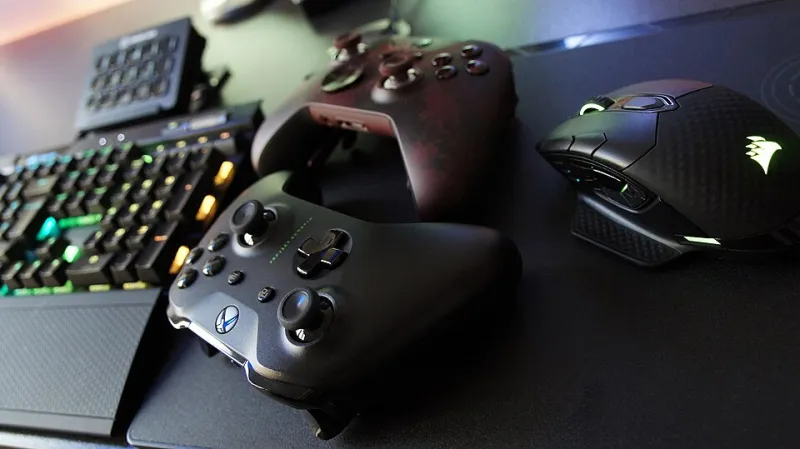
Photo: Jean-Marc Trappler, CC BY-SA 4.0, via Wikimedia Commons
Let's be honest for a second. Most of us grabbed whatever controller came in the box, plugged in whatever mouse was on sale at Best Buy, and called it a day. And hey, it works. You're playing games. Life is good.
Except—is it? Because there's a version of your gaming life where the inputs feel like an extension of your brain instead of a translation layer between your intentions and the screen. And a lot of players never get there, not because they lack skill, but because they never questioned the gear sitting in front of them.
This isn't a gear-snob piece. Nobody's telling you to spend $200 on a mouse or drop rent money on a custom arcade stick. But there's a real conversation to be had about how peripheral choices shape your experience in ways that go way deeper than specs on a product page.
The Muscle Memory Trap
Here's the thing about muscle memory: it doesn't care whether you're practicing good habits or bad ones. It just locks in whatever you repeat.
If you've been playing shooters with a controller that has a slightly sticky left trigger, your brain has already compensated. You've built micro-adjustments into your playstyle without even realizing it. Switch to a clean, responsive trigger and suddenly your aim feels off—even though objectively it's better. That disorientation is your muscle memory throwing a fit.
This is why a lot of gamers resist upgrading even when they know their gear is subpar. It's not stubbornness. It's neuroscience. The short-term regression that comes with switching peripherals feels like the new gear is worse, when really you're just in the awkward relearning phase.
The players who push through that phase almost universally report that they can't imagine going back. That's the real cost of sticking with 'good enough'—you're not just playing with inferior hardware, you're actively training yourself to compensate for it.
Genre Mismatch Is More Common Than You Think
Different game genres have genuinely different input demands, and a one-size-fits-all approach leaves a lot of performance on the table.
Take fighting games. If you've been grinding Street Fighter or Mortal Kombat on a standard gamepad and wondering why your combo execution feels inconsistent, you might not be the problem. Traditional d-pads on most modern controllers aren't actually designed with precision quarter-circle and half-circle motions in mind. Arcade sticks—or even a good hitbox-style controller—give you a physical input language that matches what those games were originally designed around. Players who make the switch often describe it as the game suddenly making sense in a way it never quite did before.
On the flip side, real-time strategy games and MOBAs are almost unusable without a mouse and keyboard. The granular control, the speed of clicking between units, the hotkey access—a controller just can't replicate that. Yet plenty of players try to make it work on console ports and wonder why they feel clumsy.
For shooters, the mouse vs. controller debate is genuinely nuanced. On PC, a mouse offers precision that a thumbstick mechanically cannot match. But aim assist on console is specifically engineered to close that gap, and some players actually perform better with a controller because their muscle memory is so deeply grooved there. Knowing which category you fall into is worth figuring out.
Real Players, Real Upgrades, Real Results
Communities on Reddit—particularly r/fightsticks, r/MouseReview, and r/patientgamers—are full of stories from everyday players who made relatively affordable gear changes and saw genuine improvements.
One common thread: players who switched from a standard DualSense or Xbox controller to a budget arcade stick (you can find decent entry-level options in the $50–$80 range) and finally started landing the combos they'd been fumbling for months. The physical feedback from a joystick and individual buttons just clicks differently for a lot of people.
Another recurring story involves PC players upgrading from a $15 office mouse to a mid-range gaming mouse in the $40–$60 range—not a flagship, just something with a reliable sensor and a shape that fits their grip. The difference in tracking consistency, especially in fast-paced shooters, tends to be immediately noticeable.
None of these are life-changing purchases. But the performance and enjoyment uplift people describe is disproportionate to the cost, which says a lot about how much the 'good enough' mentality holds people back.
The Psychology of 'It's Fine'
There's something worth unpacking about why gamers—who often care deeply about the quality of the games themselves—tend to be so passive about the tools they use to play them.
Part of it is that peripherals are invisible when they work. A great controller doesn't announce itself. You just feel more in control, more fluid, more in the zone. The gear disappears into the experience. Bad gear does the opposite—it creates friction you eventually stop noticing because your brain has normalized it.
That normalization is the trap. When you've never felt what a well-matched peripheral feels like in your specific context, you don't know what you're missing. You just assume that the slight lag, the imprecise input, the hand cramp after an hour—that's just gaming.
It doesn't have to be.
Where to Start Without Wasting Money
If you're curious about whether your gear might be holding you back, the smartest first move isn't buying anything. It's borrowing.
If you have a friend with a different controller or a nicer mouse, spend a session playing your main game with their setup. Pay attention to how it feels, not just immediately but after 30 or 40 minutes when your hands have started to settle in. That's your baseline comparison.
From there, identify the one game genre you play the most and research what experienced players in that community actually recommend for entry-level gear. Fighting game communities are especially good about this—they have detailed guides for players moving from pad to stick that are genuinely helpful and budget-conscious.
The goal isn't to build a $500 peripheral setup. It's to make sure the tools in your hands match the games you love. Because when they do, the game stops feeling like something you're fighting against and starts feeling like something you're actually playing.
And that difference? That's worth more than any upgrade spec sheet can quantify.